July 31, 2026
Best Cyber Law Courses in India | Career Roadmap & Certification Guide
Author: Advocate Ravi Rai Sharma | Category: Legal Education & Career Advisory | Target Audience: Law Students, Lawyers, & IT Professionals
The digital world is growing faster than ever, but this has also brought a massive flood of online scams, data leaks, and corporate hacking cases. Today, companies, banks, and normal citizens are constantly looking for experts who understand digital safety and technology laws.
For law students, practicing advocates, and young IT professionals, learning how to become a cyber lawyer is no longer just an extra skill—it is one of the highest-paying and most secure career paths today. However, the internet is full of fake websites offering useless certificates.
To help young minds, Advocate Ravi Rai Sharma has created this simple and honest guide. It filters out the confusion to show you the most respected, government-approved, and best cyber law courses in india. Whether you want a flexible cyber law diploma for lawyers to upgrade your court practice or you are a student looking for cyber law course eligibility, this guide has everything you need.
(Note: If you are an IT professional or a business owner facing corporate loan issues or property notices alongside your digital work, you can read our simple financial rescue guide: Bankruptcy Lawyer in Jaipur: Legal Protections Against Property Seizure & Loan Defaults).
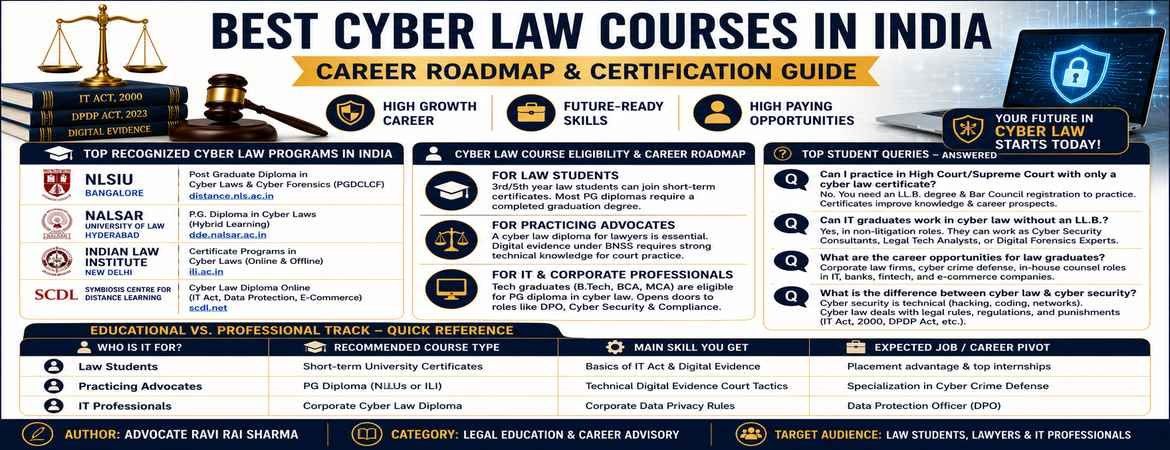
🎓 Top Recognized Cyber Law Programs in India (Official Enrollment Portals)
Since our legal chamber focuses entirely on court litigation and company corporate advice, we do not provide these educational courses ourselves. Instead, we have selected the top university and distance-learning programs based on their value in the job market. You can click and apply directly through their official websites below:
- NLSIU Bangalore (Distance Education Department): Offers a highly respected Post Graduate Diploma in Cyber Laws & Cyber Forensics (PGDCLCF). This adds massive institutional weight to any lawyer's resume.
- NALSAR University of Law (Directorate of Distance Education): Known for its advanced P.G. Diploma in Cyber Laws which comes in a very flexible, hybrid learning format made for busy professionals.
- Indian Law Institute (ILI), New Delhi: A great option for college students during their semester breaks, offering top-quality online and offline certificate programs in Cyber Laws.
- Symbiosis Centre for Distance Learning (SCDL): Offers a comprehensive cyber law diploma online that teaches corporate data protection, the IT Act, and e-commerce business safety rules.
📋 Cyber Law Course Eligibility & Simple Career Roadmap
Before joining any course, students and young professionals should understand who can apply and how it helps their career:
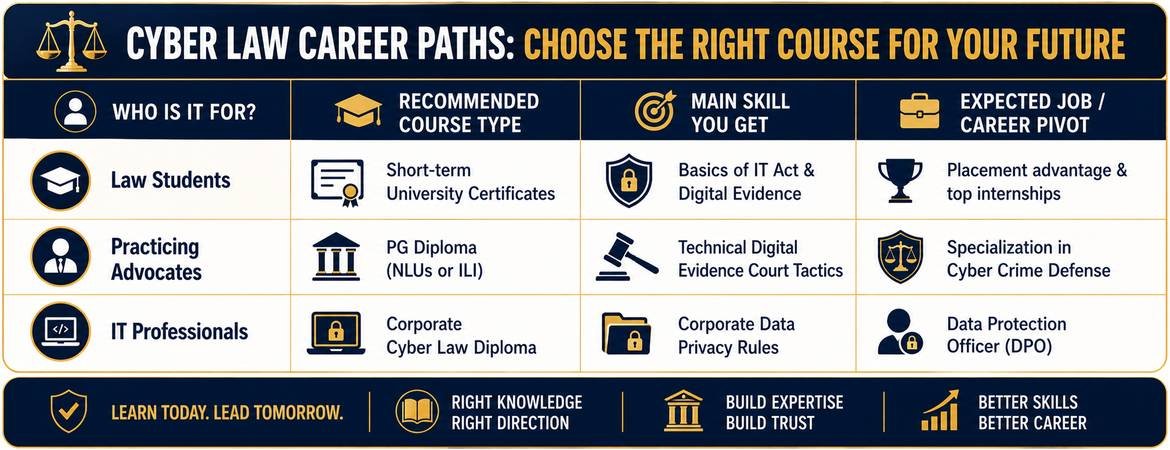
- For Law Students (LL.B. or Integrated Law Courses): Most big post-graduate diplomas ask for a completed graduation degree. However, if you are in your 3rd or 5th year of law school, you can easily join 3-month to 6-month online certificate programs from national universities to make your CV stand out.
- For Practicing Advocates: Getting a flexible cyber law diploma for lawyers is highly necessary now. The new digital evidence rules under the Bhartiya Nagarik Suraksha Sanhita (BNSS) require lawyers to have solid technical knowledge of electronic records to cross-examine witnesses in court properly.
- For IT & Corporate Professionals: You do not need to be a lawyer to learn cyber law! Tech graduates (B.Tech, BCA, MCA) are fully eligible for a post graduate diploma in cyber law. This helps them get hired as Data Privacy Officers (DPO) and Information Security Compliance Managers in top companies.
(Note: If your active legal interest lies in verifying property titles or solving local JDA land construction clashes instead of academic paths, you can access our core structural resource: Best Real Estate Lawyer in Jaipur: Property Disputes & RERA Compliance Guide).
❓ Frequently Asked Questions (Top Student Queries Solved in Easy Words)
Q1. Can I practice independently in the High Court or Supreme Court just by doing an online cyber law certificate?
Ans: No. A certificate or diploma gives you great knowledge and improves your resume, but it does not give you the right to fight cases in court. To practice as an advocate in India, you must have a proper LL.B. degree and be registered with the Bar Council of India (BCI). However, these courses heavily help you win complex cybercrime and online fraud cases.
Q2. Can a B.Tech or IT graduate work in the cyber law field without an LL.B. degree?
Ans: Yes, but not as an advocate in court. While you need an LL.B. to stand before a judge, IT graduates with a post graduate diploma in cyber law can easily work inside corporate firms as Cyber Security Consultants, Legal Tech Analysts, or Digital Forensics Experts who help the police and companies solve digital crimes.
Q3. What are the actual cyber law career opportunities for young law graduates in India?
Ans: The cyber law career opportunities are vast and growing every day. Young lawyers can work in:
- Corporate Law Firms: Making privacy policies and terms of service for new tech startups and apps.
- Cyber Crime Defense: Handling court cases related to online banking frauds, identity theft, and data hacking.
- In-house Company Lawyer: Working directly for IT companies, private banks, and online shopping apps to manage digital risks.
Q4. What is the basic difference between a Cyber Law Course and a Cyber Security Course?
Ans: This is a very common point of confusion for youngsters. A Cyber Security course is completely technical—it teaches coding, ethical hacking, and network firewalls. A Cyber Law course teaches the rules, regulations, court procedures, and punishments (like the IT Act, 2000 and the DPDP Act) that govern those technical systems.
📊 Educational vs. Professional Track: Quick Reference Table