January 19, 2026
Best Criminal Lawyer in Jaipur | Criminal Defense & Section 41A CrPC Notice Guide
Author: Advocate Ravi Rai Sharma | Category: Criminal Defense & Cyber Litigation | Jurisdiction: Jaipur District Courts, Rajasthan RERA, & Rajasthan High Court
Navigating the criminal justice system requires a criminal advocate with deep expertise in complex criminal procedures, trial strategies, and penal law. In a bustling metropolitan center like Jaipur—spanning busy commercial zones from Sitapura to Mansarovar and C-Scheme—facing a sudden police investigation or a criminal charge can turn your life upside down in seconds.
When a legal emergency strikes, individuals instantly search online for a criminal defense attorney near me or try to decode a cognizable offence notice under panic. Whether you are dealing with a false allegation, an unbailable warrant, or an unexpected police summon, securing immediate strategic legal protection is vital to safeguard your personal liberty.
At Legal Ravi, we provide a robust, tactical defense for individuals facing criminal offences, ensuring justice is served in the Jaipur District Courts, the Sessions Courts, and the Rajasthan High Court.
(Note: If your active legal emergency involves complex financial defaults, commercial property attachments, or corporate bank notices rather than police station trials, read our debt-relief guide: Bankruptcy Lawyer in Jaipur: Legal Protections Against Property Seizure & Loan Defaults).
🏛️ Detailed Classification of Criminal Offences in India
Understanding the specific nature of a criminal charge is the absolute first step toward building a successful trial defense. Under the Indian penal framework, criminal offences are systematically categorized based on their severity, the police's power to arrest, and the type of harm caused:
1. Cognizable Offence vs. Non-Bailable Offence
- Cognizable Offence: These are serious or heinous crimes where a skilled criminal advocate is needed immediately because the police possess the statutory power to arrest an accused without a warrant and initiate investigations without a magistrate's prior order. Examples include murder, rape, kidnapping, and major theft of property.
- Non-Cognizable Offence: Less severe criminal infractions, such as defamation or simple public nuisance, where the police cannot arrest you without a formal warrant issued by a competent magistrate.
- Non-Bailable Offence: While minor crimes allow bail as a matter of right, a non-bailable offence means securing freedom is at the complete discretion of the court. Our experienced criminal defense attorney team specializes in moving the Sessions Court and the High Court for swift bail allocations in these high-stakes scenarios.
2. White-Collar Offense vs. Traditional Crimes
- White-Collar Offense: Non-violent criminal acts committed by professionals or corporate entities for illegal financial gain. We provide strategic defense against complex allegations of corporate fraud, tax evasions, cybercrime, cheating, and criminal breach of trust.
- Blue-Collar / Traditional Crimes: Offences involving direct physical actions or local disputes, such as severe assault charges, a battery offence, trespass, or local theft crimes.
3. Offences Against Property: From Theft to Breach of Trust
Property crimes are governed by strict criminal procedures under the CrPC 1973 (and the latest BNSS codes):
- Theft and Dacoity: Theft involves moving movable property dishonestly out of a person's possession without consent. If five or more people conjointly commit or attempt to commit a robbery, it escalates to the severe charge of dacoity.
- Criminal Breach of Trust Meaning: This occurs when a person is legally entrusted with property or dominion over it, but they dishonestly misappropriate, convert, or use it for themselves in violation of law. We handle intricate defense setups for high-value cases involving cheating and criminal breach of trust.
🛡️ Know Your Rights: The Section 41A CrPC (Section 35 BNSS) Notice Shield
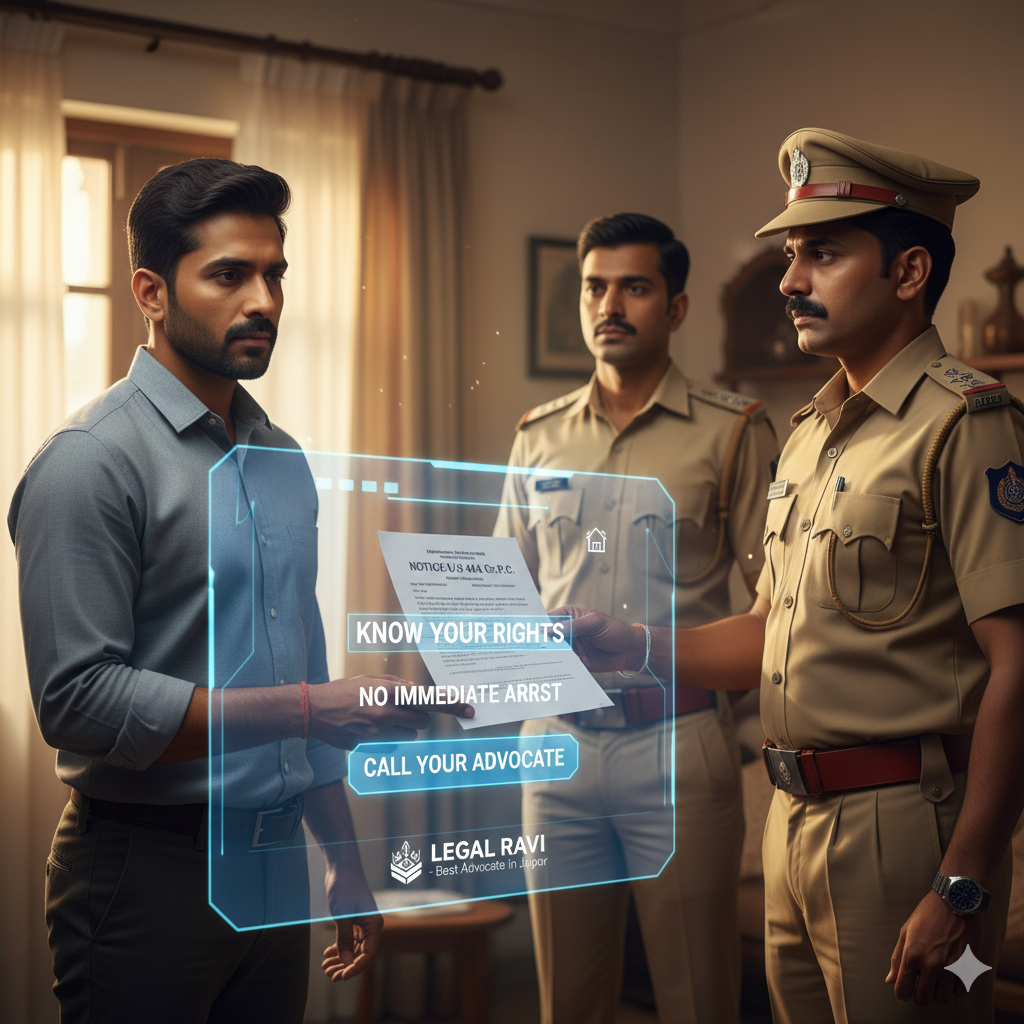
In the criminal justice system, receiving an official police notice can be a terrifying experience. However, under Section 41A of the CrPC (now beautifully updated under Section 35 of the Bhartiya Nagarik Suraksha Sanhita - BNSS), you possess a powerful constitutional shield against arbitrary or forced arrest. As the best criminal lawyer in jaipur, Advocate Ravi Rai Sharma ensures that your rights are aggressively protected from the exact moment a notice arrives.
Why Did You Receive a 41A CrPC Notice?
The police issue a 41A order of appearance when a reasonable complaint or credible information suggests your involvement in a cognizable offence, but an immediate arrest is not legally necessary.
- The Arnesh Kumar Guidelines: In the landmark judgment of Arnesh Kumar v. State of Bihar, the Supreme Court mandated that police cannot execute automatic arrests in offences carrying punishments under 7 years (such as domestic disputes, cheating, or mild assault charges). The Investigating Officer (IO) must record specific written reasons if they choose to arrest instead of issuing an appearance notice.
Your Fundamental Rights During Inquiry
- Right to Legal Representation: You have the absolute right to consult a defense lawyer before stepping into a police station and to have your counsel present (at a visible distance) during inquiries.
- Right Against Self-Incrimination: Under Article 20(3) of the Constitution, you cannot be forced to be a witness against yourself. You should provide standard factual info but completely avoid admitting to a criminal charge without explicit legal advice.
- Right to Information: You are entitled to know the complete details of the criminal offence meaning and the exact allegations leveled in the primary FIR.
- Protection from Arrest: As long as you comply with the terms of the notice and cooperate transparently with the investigation, the police cannot arrest you without a specific court order or heavily recorded written justifications.
⚙️ Critical Steps to Take After Receiving a Police Notice
Failure to handle a Section 41A CrPC notice correctly can result in the immediate issuance of a non-bailable criminal warrant:
- Step 1: Verify the Notice: Ensure it is a formal, authenticated written order. The courts have established that loose electronic notifications (like unofficial WhatsApp texts) are not a valid substitute for the prescribed statutory mode.
- Step 2: Consult a Criminal Advocate: Never enter a police station alone under panic. A seasoned defense lawyer will help you compile a legally sound, formal reply to the notice to avoid traps of self-incrimination.
- Step 3: Move for Anticipatory Bail: If you genuinely fear that the investigating team might manipulate facts or record biased reasons to execute a sudden arrest, our chamber files an Anticipatory Bail Application under Section 438 CrPC (Section 482 BNSS) in the Jaipur Sessions Court or the Rajasthan High Court as a pre-emptive shield.
- Step 4: Secure Attendance Acknowledgement: When you appear for the inquiry, always demand an official, signed acknowledgement of your physical presence from the Investigating Officer (IO) for court records.
What Happens if You Ignore a 41A Notice?
Ignoring a formal notice is a dangerous error. The police can instantly secure a arrest warrant from a magistrate, and the court may view your non-compliance as an adverse inference, severely hurting your chances of getting regular bail later during the criminal sentencing stages.
🌐 Official Portals for Real-Time Criminal Case Tracking
Our criminal defense chamber structures tactical trial defenses backed by deep statutory research. To monitor FIR registries, check running case steps, or read apex court directives independently, you can access the authorized government portals below:
- Digital Police Citizen Portal - MHA: The centralized national network maintained by the Ministry of Home Affairs to verify criminal databases, report offenses, and access citizen safety logs.
- eCourts Services India Network: The direct judicial gateway to track lower court criminal trial stages, verify a criminal warrant status, and monitor case lists across Jaipur District Courts.
- Supreme Court of India Official Site: Read historical landmark judgments, track pending criminal appeals, and review updated guidelines on preventive detention under Section 111 CrPC.
(Note: If your dispute relates to matrimonial splits, contested family court procedures, or mutual separation terms instead of police station litigation tracks, read our guide: Best Divorce Lawyer in Jaipur: Mutual Consent & Alimony Guide).
❓ Frequently Asked Questions (Criminal Procedures Solved Simply)
Q1. What is the basic difference between a warrant trial and a summons trial under CrPC?
Ans: A Warrant Trial relates to serious criminal offences punishable by death, life imprisonment, or a jail term exceeding 2 years, requiring structured charge-framing procedures. A Summons Trial deals with lesser offenses (punishment under 2 years) where the process is shortened, and the judge can directly explain the accusation to the accused without framing formal written charges.
Q2. Can a false FIR for a cognizable offence be cancelled before the trial starts?
Ans: Yes. If someone files a completely fake or malicious FIR against you to settle a personal grudge, your defense lawyer can file a quashing petition under Section 482 CrPC (now Section 528 BNSS) directly in the Rajasthan High Court. If the court finds no prima facie case, it will permanently quash the FIR.
Q3. How does a specialized cyber crime advocate defend financial fraud cases?
Ans: Modern white-collar crimes rely heavily on electronic records. A specialized cyber crime lawyer near me defends clients by auditing IP address logs, challenging the electronic chain of custody, and ensuring that digital evidence is strictly backed by a valid validation certificate under Section 63 of the Bhartiya Sakshya Adhiniyam (BSA).
Q4. What are prevention proceedings under Section 111 of the CrPC?
Ans: Section 111 CrPC (carried into the new codes) is a preventive law tool used by magistrates to maintain public peace. If the administration fears a local conflict, they issue a notice asking you to show cause why you shouldn't sign a bond for good behavior. We represent clients in these matters to completely prevent wrongful or arbitrary preventive detentions.
📊 Tactical Breakdown: Key Milestones of a Criminal Trial
Trial PhaseProcedural ActionImmediate Legal Protection1. FIR & Notice StageIssuance of Section 41A CrPC / 35 BNSS notice.Protection from arbitrary arrest via Arnesh Kumar guidelines.2. Bail AssessmentFiling for Regular Bail or Anticipatory Bail.Safeguards physical liberty and ensures trial participation.3. Framing of ChargesCourt reviews police charge sheet and evidence files.Defense can argue for absolute discharge if evidence is weak.4. Trial & JudgmentRigorous cross-examination of state witnesses.Leads to final acquittal or assessment for criminal sentencing.
📋 Law Student’s Essential Toolkit: Trial Vocabulary
Before applying for top-tier internships or clerkships, ensuring a firm grasp of these active trial phrases is highly critical:
- [ ] Cognizable Offence: Police can arrest without a warrant; handles severe offenses.
- [ ] Proclaimed Offender: An accused hiding from a non-bailable criminal warrant.
- [ ] Section 482 CrPC / 528 BNSS: The inherent power of the High Court to quash false cases.
- [ ] Section 63 BSA Certificate: Mandatory legal requirement to make electronic logs admissible.
🏁 Secure Your Absolute Freedom Today
Your search for the best civil lawyer, top divorce advocate, and best criminal advocate in jaipur ends here. Advocate Ravi Rai Sharma combines aggressive courtroom trial advocacy with profound procedural knowledge of the CrPC 1973 and BNSS 2023 to dismantle false cases. Don't let a police notice or a malicious complaint compromise your future. A single consultation today can save you from a lifetime of regret.
Contact Advocate Ravi Rai Sharma Now.
- Main Chambers: Jaipur, Rajasthan.
- Practicing At: Rajasthan High Court (Jaipur Bench), Jaipur District & Sessions Courts, & Supreme Court of India (New Delhi).