July 25, 2026
BCI Draft Advocates (Amendment) Bill, 2026: An Legal Breakdown of Women’s Reservation, Law Firm Status, and Enrollment Fee
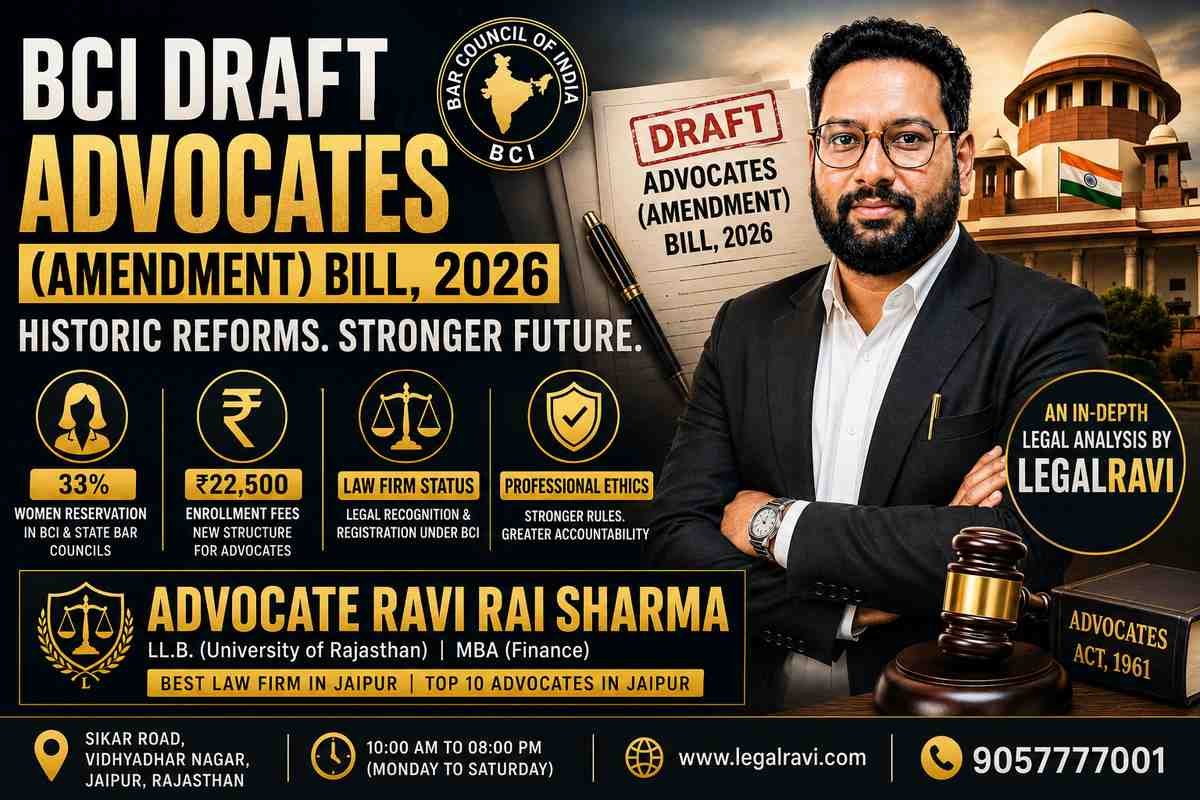
The statutory architecture governing the Indian legal ecosystem is undergoing its most radical transformation since the enactment of the Advocates Act, 1961. On July 18, 2026, the Bar Council of India (BCI) officially released the highly anticipated Draft Advocates (Amendment) Bill, 2026 for public consultation. The council has invited comprehensive recommendations and critiques from state bar associations, senior practitioners, and academic stakeholders, setting a strict submission deadline of July 31, 2026.
This draft seeks to modernize professional ethics, introduce strict institutional compliance, and structurally realign litigation metrics with the national vision of Viksit Bharat @2047. As a firm anchored by multi-disciplinary elite competencies—holding an LL.B. from the University of Rajasthan alongside a core MBA in Finance—the Chambers of Advocate Ravi Rai Sharma (LegalRavi), widely recognized among the top 10 advocates in jaipur, presents a highly detailed, humanized, and transparent evaluation of the four most disruptive pillars of this proposed legislation.
🏛️ 1. The Statutory Evolution: Section 6 Amendments & 33% Women’s Reservation
In an extraordinary move toward complete structural inclusivity, the 2026 Draft Bill introduces a landmark 33% gender quota for women advocates within legal governance boards.
· The Mandate: Proposed amendments targeting the leadership composition of both the Bar Council of India and respective State Bar Councils dictate that one-third of all seats must be explicitly reserved for women. This encompassment includes both standard elected members and co-opted structural representatives.
· The Institutional Shift: Historically, regulatory organs within the legal grid have faced criticism for minimal female representation at executive desks. By legally embedding gender parity into the core text of the Act, the BCI ensures that women practitioners sit at the absolute epicenter of high-level policymaking, welfare fund governance, and disciplinary standardizations.
💰 2. The Great Financial Disaster: Escalated State Enrollment Fees
The most volatile point of contention within the draft involves the legal recalibration of entry-level costs for aspiring advocates. The BCI has introduced a heavy adjustments layout to Section 24 of the Act, revising the uniform fee matrix as follows:
Regulatory Recipient Entity
Proposed Statutory Standard Fee (2026 Draft)
Concessional Matrix (SC/ST & Benchmark Disabilities)
State Bar Council (Enrolment Component)
₹18,000
One-Fourth of Prescribed Fee (Concession applied to alleviate severe financial hardship)
Bar Council of India (BCI Component)
₹4,500
One-Fourth of Prescribed Fee (Concession applied to alleviate severe financial hardship)
Gross Total Financial Outlay
₹22,500
₹5,625 Total
🔍 The Judicial Precedent Context: Gaurav Kumar v. Union of India
This sharp financial upward revision serves as a direct legislative counter-blast to the historic ruling of the Supreme Court of India in the landmark case of Gaurav Kumar v. Union of India (2024), where the apex court explicitly struck down exorbitant enrollment fees charged by various State Bar Councils, labeling them as unauthorized under the original text of the 1961 Act.
Relying on our extensive background in Corporate Auditing and Finance (MBA), our analysis shows that the BCI is attempting to build a self-sustaining operational fund via statutory amendments. The council justifies this sharp hike by citing the mounting operational costs of conducting biometric qualification checks, maintaining nationwide digital rolls, and establishing extensive advocate insurance and pension trusts under updated welfare mandates. However, young law graduates argue that this high entry fee creates an immediate barrier for talent from lower-income brackets.
🏢 3. Chapter IIIA Integration: Formal Statutory Identity for Law Firms
For the first time in Indian legal history, partnerships, associations, and collective entities will transition from generic corporate laws into specialized legal practice recognition. By inserting a brand-new Chapter IIIA (Sections 28A and 28B), the draft formally brings Indian Law Firms under the direct regulatory supervision of the BCI.
· The Law Firm Definition: A law firm is officially defined as a registered partnership under the Indian Partnership Act, 1932, a Limited Liability Partnership (LLP), or a specialized company entirely constituted of enrolled advocates.
· Mandatory BCI Registration: All functional legal firms must apply for and maintain separate statutory registration certificates from the Bar Council.
· The In-House Counsel Exclusion Controversy: In a massive last-minute twist, the 2026 draft explicitly excludes Corporate General Counsels (GCs) and salaried in-house corporate lawyers from the core definition of a "legal practitioner". This reinforces the traditional line separating active courtroom practitioners from full-time salaried corporate staff.
🚫 4. Guarding the Litigation Gates: Absolute Ban on Foreign Law Firms
The 2026 Draft Bill takes a strong protective approach to domestic litigation. It completely bars foreign citizens, overseas lawyers, and international law associations from entering the Indian courtroom domain.
· No Litigation Rights: Foreign entities are explicitly barred from entering appearances, filing pleadings, or setting up core litigation practices before any Indian court, tribunal, or statutory authority.
· The "Fly-In, Fly-Out" Advisory Window: The draft introduces a very limited advisory window. Foreign lawyers may be permitted to visit India on a temporary "fly-in, fly-out" basis solely to pitch non-Indian legal systems or participate in high-value International Commercial Arbitration matters where foreign law explicitly governs the root dispute. Even this minor concession requires mandatory prior authorization from the Central Government.
🔗 The Parallel Legislative Alignment: BNS, BNSS, and Examination Security
The modern Indian lawyer can no longer function inside an isolated silo. This full renovation by the BCI runs completely parallel to the full countrywide transition into the new procedural and penal criminal systems—Bharatiya Nyaya Sanhita (BNS) and Bharatiya Nagarik Suraksha Sanhita (BNSS).
Furthermore, as institutional security becomes the primary focus of the government—evident in the recent historic updates regarding the NEET-UG 2026 Paper Leak Anti-Cheating Amendments—the BCI has also empowered itself under Section 7 to conduct unified national entrance tests for legal degree courses and completely reform the All India Bar Examination (AIBE) infrastructure.
🤝 LegalRavi: Your Trusted Legal Advisor and Strategic Partner in Jaipur
As a premier litigation house positioned at the absolute apex of the rajasthan high court advocates list, the Chambers of Advocate Ravi Rai Sharma combine elite analytical skill with sharp courtroom strategies. Whether you are a newly forming legal partnership requiring structural risk alignment under the new Chapter IIIA rules, an educational group dealing with standard compliance overhauls, or a corporate entity needing high-court litigation defense, our desk provides dedicated, clear, and unyielding results.
· 📍 Head Office: Sikar Road, Vidhyadhar Nagar, Jaipur, Rajasthan
· ⏰ Working Hours: 10:00 AM to 08:00 PM (Monday to Saturday)
· 🌐 Official Platform: www.legalravi.com
· 💼 Consult Options: In-Chamber Confidential Mapping | Secure Encrypted Video Conference