July 05, 2026
Bank Recovery Agents Harassing You in Jaipur? Legal Remedies to Stop Harassment Immediately.
Article Written By Advocate Ravi Rai Sharma (LegalRavi)
Primary Practice Areas: Debt Recovery Tribunal (DRT) Rajasthan, High Court of Rajasthan (Jaipur Bench), and Strategic Debt Defense.
"Facing severe financial distress or aggressive bank recovery actions can be overwhelming. Knowing how to protect your business assets under the guidance of a verified bankruptcy lawyer in jaipur is the first step toward relief."
Imagine coming home after a grueling day of work in Mansarovar or C-Scheme (Jaipur), hoping to find peace with your family, only to be startled by an aggressive, continuous knocking on your front door. You open it, and instead of a neighbor or a delivery agent, you are confronted by three built, aggressive men. They don't introduce themselves politely. Instead, they shout, use abusive language, and threaten to throw your family out on the street because a business loan or a credit card payment defaulted a couple of months ago.
If this sounds familiar, you are not alone. With the economic shifts stretching across businesses in Jaipur, financial distress has become a silent reality for many traders, shopkeepers, and salaried professionals.
However, there is a massive line between recovering a legal debt and criminal extortion. Many private banks, non-banking financial companies (NBFCs), and digital lending apps cross this line daily by hiring third-party bouncers masked as "recovery agents."
As a practicing advocate dealing with banking laws and debt defense right here in Jaipur, let me tell you something clearly: A loan default is a civil breach of contract; it is not a criminal crime, and nobody has the right to strip you of your dignity.
This comprehensive guide is written to give you immediate, practical, and highly strategic plans to stop this harassment, using the latest legal protections.
1. A Civil Dispute is Not a Crime
The first weapon a recovery agent uses against you is not a legal notice—it is fear. They deliberately try to make you feel like a criminal who is about to be locked up by the police.
Let's shatter this myth right now. Under Indian law, failing to pay an Equated Monthly Installment (EMI) due to business losses, a medical emergency, or job loss is strictly a civil matter.
· No Arbitrary Arrests: The police cannot simply march into your house and arrest you because your loan turned into a Non-Performing Asset (NPA).
· No Self-Styled Lockouts: No bank or private agent can put their own lock on your shop in Johari Bazar or your residential flat in Jagatpura without a specific order from a competent judicial authority.
When you understand that the law protects your personhood even when you owe money, the fear vanishes. And once the fear vanishes, the recovery agents lose half their power.
2. The Strict RBI Guidelines: Your Legal Shield
The Reserve Bank of India (RBI) has repeatedly pulled up banks and financial institutions for employing rough recovery tactics. The regulatory framework establishes clear boundaries that no recovery agent can breach without inviting severe penalties for their parent bank.
"According to the strict fair practices framework laid down under the Reserve Bank of India Guidelines, Guidelines for the recovery agents, lenders and their recovery departments are bound by legal time windows and ethical codes of conduct that restrict unnecessary interference with a borrower's privacy."
If an agent contacts you, measure their behavior against these strict rules:
A. The Permissible Time Window (8:00 AM to 7:00 PM)
Recovery agents cannot turn your life into a 24-hour nightmare. They are strictly prohibited from calling you or showing up at your doorstep before 8:00 AM in the morning or after 7:00 PM in the evening. Any call at 10:00 PM or a surprise visit at 6:00 AM is a direct violation of RBI guidelines.
B. Complete Ban on Privacy Invasion and Public Shaming
A debt is strictly between you and the lender. Agents cannot call your relatives, message your friends, or visit your workplace to tell your boss or colleagues about your financial problems. Standing outside your house in a residential colony in Vaishali Nagar and shouting loudly to ensure your neighbors gather to watch the humiliation is a flagrant breach of your fundamental Right to Privacy.
C. The Absolute Ban on Anonymous Coercion
An agent cannot call you from private, unlisted numbers or send threatening messages on WhatsApp using anonymous profiles. Furthermore, digital lending apps cannot access your phone's contact list or photo gallery to threaten you with morphed images—a practice that has faced massive crackdowns.
D. Mandatory Credentials and Identification
Whenever an agent knocks on your door or visits your office, they must carry two things:
1. An official, clear Photo ID Card issued by the bank or the registered recovery agency.
2. A copy of the bank's formal Authorisation Letter proving they have been legally assigned to your specific account.
If they fail to produce these credentials upon request, you have every right to refuse to speak with them and ask them to leave your property immediately.
3. Taking the Offensive: Filing a Police FIR Under New Criminal Laws
When recovery agents cross into verbal abuse, physical intimidation, or extortion, they are no longer recovering money—they are committing criminal offenses under the Bharatiya Nyaya Sanhita (BNS).
Do not just argue with them. Start recording their actions on your phone, gather video evidence, and head to your local Jaipur police station (such as the Mansarovar, Shyam Nagar, or C-Scheme Police Station) to file a formal complaint under the following provisions:
· Section 351 (2) and 352 BNS (Criminal Intimidation): This applies when an agent threatens you, your spouse, or your children with physical harm, social ruin, or dire consequences if the money isn't paid immediately.
· Section 356 BNS (Defamation): If agents deliberately humiliate you in front of your neighbors, paint messages on your walls, or contact your social circle to destroy your reputation, they can be prosecuted for criminal defamation.
· Criminal Trespass and Extortion: Entering your home or business premises without your explicit permission after being asked to leave constitutes criminal trespass. Forcibly snatching your car keys, motorcycle, or office laptops without a valid court seizure order amounts to extortion and theft.
A single copy of a police complaint or an FIR sent to the bank’s regional head is often enough to ensure that the aggressive agents are permanently pulled off your case.
4. Escalating to the RBI Banking Ombudsman
If writing a complaint to the bank’s internal grievance redressal cell yields no response within 30 days, your next step should be escalating the matter to the RBI Integrated Ombudsman.
This is an incredibly powerful, decentralized, and entirely free dispute resolution platform provided by the central bank. You can lodge your complaint online through the official RBI portal (cms.rbi.org.in), attaching your phone call logs, abusive WhatsApp screenshots, or CCTV footage of the agents' misbehavior.
The Impact of an Ombudsman Complaint
The RBI treats recovery harassment with zero tolerance. When an Ombudsman complaint is triggered:
· The bank is forced to halt its routine recovery process to file an official response.
· If the harassment is proven, the Ombudsman can levy heavy financial penalties on the institution.
· The bank can be ordered to pay substantial direct compensation to you for the mental agony, loss of reputation, and stress caused by their third-party agents.
"If the bank ignores your grievance, you can file an official online complaint directly at the RBI Integrated Ombudsman Portal.
5. Navigating High-Value Disputes: Consumer Courts and DRT Jaipur
Depending on the scale of your financial dispute, you have access to specialized judicial bodies designed to check the high-handedness of banking institutions.
A. The Consumer Protection Act, 2019
Employing abusive, untrained, and aggressive recovery agents is legally categorized as a severe Deficiency in Service and an Unfair Trade Practice by the bank. You can file a formal case before the District Consumer Disputes Redressal Commission (Consumer Court) in Jaipur. The consumer courts have a stellar track record of penalizing mainstream banks and awarding punitive damages to harassed consumers.
B. The Debts Recovery Tribunal (DRT) Jaipur (For Loans Above ₹20 Lakhs)
If you run a business or own prime real estate in Jaipur and your secured loan has defaulted, the bank will eventually bypass manual agents and issue formal legal notices under the SARFAESI Act, 2002 (specifically Section 13(2) and Section 13(4) notices).
Once the bank issues a SARFAESI notice intending to seize and auction your residential home or commercial building, your primary battleground shifts away from standard civil courts.
Under Section 34 of the SARFAESI Act, local civil courts are barred from granting injunctions against bank recovery actions. Your exclusive, most potent legal remedy is to approach the Debts Recovery Tribunal (DRT) Rajasthan, located right here in Jaipur.
By filing a Securitization Application (SA) under Section 17 of the SARFAESI Act before the DRT Jaipur Bench, an experienced banking advocate can audit the bank's recovery process. Lenders frequently commit fatal technical and procedural errors when issuing auction proclamations or serving possession notices under Rules 8(1) and 8(2) of the Security Interest Enforcement Rules. If you are looking to secure a bank auction stay order from DRT Jaipur, timing is critical. Appellants must know how to challenge section 13 (4) possession notice within the mandatory 45 day window to protect their assets. If these technical flaws are brought to light before the DRT Judge, the tribunal has the full power to set aside the bank's action and stop a property auction cold.
"When matters escalate to the debts recovery tribunal jaipur, having a dedicated drt advocate in jaipur ensures that illegal recovery agent harassment is legally stopped and a structured debt restructuring process is initiated."
6. How a Structured Defense Can Secure Peace and Settlements
Ultimately, the goal is not just to stop the harassment for a few days—it is to resolve the underlying financial stress permanently so you can move forward with your life and business. This is where a structured legal defense strategy becomes invaluable.
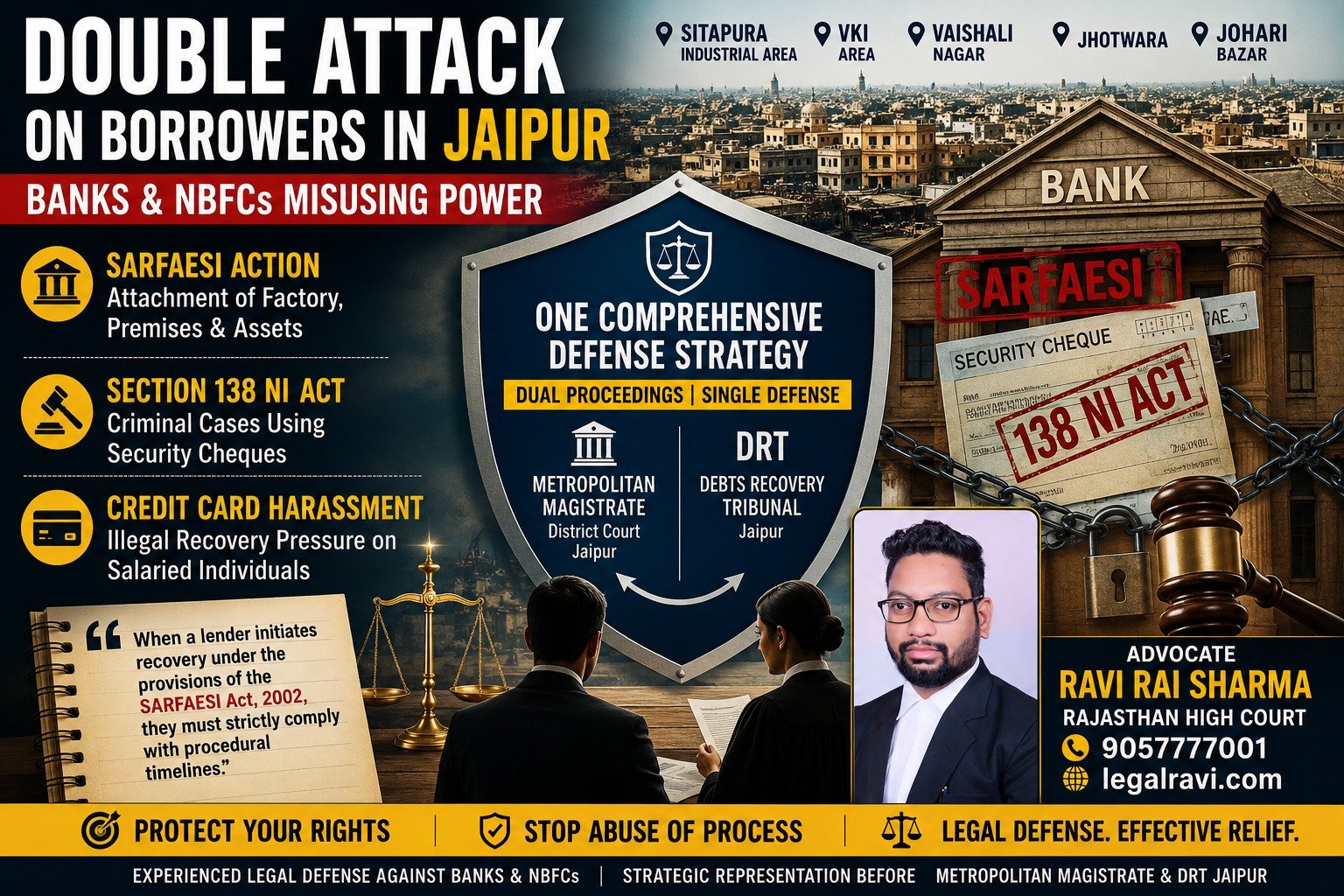
The Double Threat: Facing Parallel Action Under Section 138 NI Act and SARFAESI Act
Many business owners in Sitapura Industrial Area, VKI Area, Vaishali Nagar, Jhotwara or Johari Bazar face a double attack from financial institutions like banks and NBFC’s. Lenders often misuse security cheques to file parallel criminal cases under Section 138 of the Negotiable Instruments Act alongside SARFAESI actions. Similarly, salaried individuals face intense credit card recovery harassment in Jaipur without any legal basis. Not only does the bank attach their factory premises under the SARFAESI Act, but they also file criminal complaints under Section 138 of the Negotiable Instruments Act using the security cheques collected at the time of loan sanction.
If you are facing this coordinated legal pressure, you need a single, comprehensive defense strategy that operates simultaneously before the Metropolitan Magistrate at District Court Jaipur and the Debts Recovery Tribunal (DRT) Jaipur.
"When a lender initiates recovery under the provisions of the SARFAESI Act, 2002 Official Text, they must strictly comply with procedural timelines."
A. The Power of a Lawyer's Cease-and-Desist Notice
The moment an advocate issues a formal, technically precise legal notice to the bank's compliance officer and regional manager—detailing the exact times, dates, and names of the harassing agents along with a warning of criminal prosecution—the dynamic shifts. The bank realizes you are no longer an uninformed, frightened borrower; you are a legally represented citizen. In 90% of cases, the aggressive field agents are replaced by professional, polite bank managers.
B. Navigating One-Time Settlements (OTS)
Banks hate long, drawn-out litigation in the DRT or High Court just as much as you do. It locks up their capital and adds to their bad debt metrics.
By building a strong defense, you gain substantial leverage. This leverage can be used to negotiate a structured One-Time Settlement (OTS) on your own terms. We help clients strip away unreasonable penalty charges, hidden interest overcharges, and inflated legal fees, allowing you to settle the principal debt via an affordable, honorable, and court-sanctioned payment plan.
Need Urgent, Tactical Protection Against Bank Harassment in Jaipur?
Dealing with financial pressure is tough enough without having to protect your family from aggressive field agents knocking on your doors. Your dignity, your home, and your peace of mind are fully protected by the law of the land.
Whether you need to issue a severe legal warning to stop recovery harassment immediately, reply to a complex Section 13(2) SARFAESI notice, or secure an urgent stay order on a property auction from the Debts Recovery Tribunal (DRT) Jaipur, you do not have to fight this battle alone.
📞 Are you facing heavy business liabilities, loans or credit card reecovery harassement or institutional debt? Don't wait for legal notices to pile up. Connect with the chambers of Advocate Ravi Rai Sharma (LegalRavi) at Sikar Road, Jaipur, for a strategic and confidential legal consultation regarding bankruptcy protection and DRT defense.
· Advocate Ravi Rai Sharma (LegalRavi)
· DRT Rajasthan, Rajasthan High Court (Jaipur Bench), and Jaipur Local Courts.
· Office Location: Click Here to Schedule a Private Session at our Sikar Road, Jaipur, Rajasthan.